


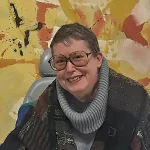




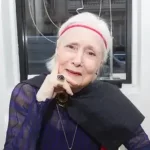



Carol Hunt was born in Berkeley, California, and studied art at the Pennsylvania Academy of the Fine Arts after receiving her A.B. from Regis College and completing graduate studies at the University of Vermont.
Selected solo exhibitions include Spanierman Modern in New York; Arlene Bujese Gallery in East Hampton, New York; Carney Gallery at Regis College in Weston, Massachusetts; Anita Shapolsky Gallery in New York; and the Time & Life Building in New York.
Selected group shows include Thirteen Contemporary Artists at Spanierman Modern in New York; Artists on Film at the Pollock-Krasner House; and East End 10 at Guild Hall Museum.
Hunt’s work is included in many private and public collections, including those of General Electric Company, Republic National Bank, Morgan Guaranty Trust Company, PepsiCo, Guild Hall Museum, Parrish Art Museum, and the University Art Gallery at SUNY Stony Brook.

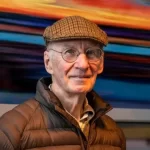
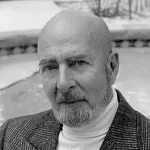
As the art world recently celebrated the 100th anniversary of the Art Deco movement, Giancarlo Impiglia—now in his eighties—has been recognized for championing and revitalizing this important aesthetic since the 1970s.
His first major commission came in 1974: a 60-foot mural that still decorates the lobby of 99 John Street in New York City, a building designed by the same architects as the Empire State Building.
That commission established Impiglia’s signature style, which is far more than decorative. Beneath the deliberate beauty of his paintings lies a critique of materialism and social superficiality. His figures often appear indifferent and anonymous, defined by the folds of their gowns and the glitter of their jewelry. As they merge into one another and into the background, their identities including their ambitions, desires, and obsessions become obscured, highlighting the fallacy of individualism and the power of trends and the market. In the age of social media, these themes remain especially relevant.
Impiglia later participated in the famed Absolut Vodka campaign of the 1980s alongside Andy Warhol and Keith Haring. Throughout the 1980s and 1990s, he exhibited extensively in New York and beyond, becoming deeply woven into the visual culture of the city.
His murals for Café Society—featured in the films Big and Boomerang—capture the glamour and theatricality of the era. He also created numerous works for Cunard’s Queens, drawing heavily from Art Deco style and the golden age of luxury sea travel. Three large murals hang aboard the QE2, now a luxury floating hotel in Dubai. Four additional murals are installed on the Queen Mary 2 and three on the new Queen Elizabeth.
His work is included in major private and public collections around the world, including those of Elton John, the Museum of the City of New York, the Victoria and Albert Museum in London, and the Wifredo Lam Center in Havana, Cuba. In 2016, he held an important retrospective at The National Arts Club in Gramercy.
Three publications document his enduring career: Giancarlo Impiglia: Paintings for the Queens (Lily Publishing, 2012), The Art of Giancarlo Impiglia (Rizzoli, 1995), and Giancarlo Impiglia: Recent Works (Rizzoli, 1982).
A Bridgehampton based artist, Impiglia has also worked as a musician, graphic designer, and photojournalist—embodying the spirit of the multidisciplinary artist who will stop at nothing to see his vision fulfilled.

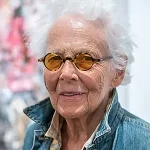
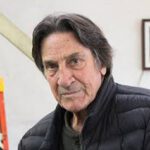
After receiving his National Diploma in Design from Hornsey College of Art in London—where he studied with Bridgit Riley and John Hoyland—Roy Nicholson attended the Brooklyn Museum School of Art. He later earned a Master of Fine Arts degree from Vermont College of Norwich University.
Nicholson’s first solo exhibition in New York took place at Kingsborough Community College in Brooklyn in 1978. Since then, he has presented solo exhibitions at Marymount Manhattan College Art Gallery, Condeso-Lawler Gallery, and Katharina Rich Perlow Gallery in Manhattan. He has also exhibited extensively in group exhibitions throughout Manhattan, including shows at Condeso-Lawler Gallery, and Katharina Rich Perlow Gallery, Bernice Steinbaum Gallery, Ludlow-Hyland, Nancy Moore Fine Art, and Doral Bank. His work has appeared in major traveling group exhibitions in Brazil, Germany, Miami, Los Angeles, and most notably AdoRnmenTs, which originated at the Bernice Steinbaum Gallery in SoHo and traveled nationally, and the Techspressionism exhibitions at the Southampton Arts Center, Kingsborough Art Museum, and Hudson Guild Gallery in Chelsea.
Nicholson’s work has been illustrated and discussed in publications including Long Island Landscape Painting: Volume II, The Twentieth Century (Little, Brown, 1990), Long Island (Crescent Books, 1986), Studios by the Sea (Abrams, 2002), Hampton Gardens: A 350 Year Legacy (Rizzoli, 2004), and Along the Way: MTA Arts for Transit (Monacelli Press, 2006).
His exhibitions have been reviewed in The New York Times, Newsday, The East Hampton Star, The Southampton Press, The Philadelphia Enquirer, Artspeak, Art and Antiques, and Long Island Life. Feature articles on his work have appeared in Hamptons Country, Dan’s Papers (featuring his painting on the cover), AAQ Art & Architecture Quarterly, Newsday, and Hampton Jitney Magazine.
He is currently represented by Ross Contemporary in Chicago and the Hamptons. His work is included in numerous private and public collections, including the Royal College of Heralds in London, Abbot Hall Art Gallery in Kendal, Guild Hall Museum, Heckscher Museum of Art in Huntington, The Long Island Museum of American Art, New Jersey Bell, and Texas Commerce Bank, Houston.
His year-long project, 52 Weeks, was exhibited at the Heckscher Museum of Art in 1998. Following purchase by the Federal Reserve Bank of Atlanta, the project is now installed in the Bank’s headquarters building. A second iteration, 52 Weeks II, was installed at The Four Seasons restaurant in Manhattan for more than a year.
Among his public commissions are Morning Transit and Evening Transit, two 7 x 33 foot glass mosaics for the Long Island Rail Road’s Hicksville station as part of the MTA Arts for Transit program. The project was among those honored by the Municipal Arts Society of New York’s 2003 Masterworks Award to the MTA. Other public projects include a 28 x 20 foot installation of nine paintings in the lobby of the Meridian Building in Columbia SC; a commission from Metro Art Los Angeles for two 55 foot long glass mosaics and a large skywell for the Gold Line Portal at Union Station, installed in 2006; and Hempstead Plain: Morning and Evening, glass panels for the LIRR Hicksville station platform waiting rooms, and two stairwell mosaics, completed in 2020.
Additional public works include installations in Columbia, South Carolina, and Los Angeles Union Station.
Nicholson is Professor Emeritus at Long Island University, where he taught full-time from 1986 to 2005. He received the Trustees’ Award for Scholarly Achievement in 2000. He lives and works in Sag Harbor, New York.

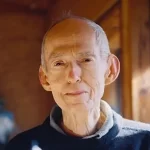
Helen A. Harrison, well known in The Hamptons,is an American art historian, curator, journalist, and author known for her extensive devotion to the study of modern American art, historical mystery novels set in the New York art world, and for serving as director of the Pollock-Krasner House and Study Center from 1990 to 2024.
From 1978 to 2006, she was an art critic for The New York Times Long Island section. Her arts commentary series, Art Waves, aired on WLIU-FM, Long Island University’s NPR-affiliated radio station, from 2004 to 2009. Her monthly column, Eye on Art, appeared in the Sag Harbor Express from 2010 to 2020.
Harrison moved to England in 1966 to attend Hornsey College of Art, where she continued her work as a sculptor. In 1967, she married British painter Roy Nicholson, whom she had met at the Brooklyn Museum Art School. After earning her master’s degree, Harrison became curator of the Parrish Art Museum in Southampton, New York, in 1977. In 1978, a chance meeting with an editor at The New York Times launched a 28-year relationship with the newspaper, for which she wrote regular art reviews and occasional feature articles until the section was discontinued in 2006.
In 1979, the Queens Museum in Flushing, New York invited Harrison to organize an exhibition devoted to the 1939–40 New York World’s Fair. The resulting exhibition, Dawn of a New Day: The 1939/40 New York World’s Fair, was presented in 1980.
From 1980 to 1982, she served as director of the Public Art Preservation Committee, an initiative funded by the New York State Council on the Arts to document and advocate for art in public spaces throughout New York City. She became curator of Guild Hall Museum in 1982 before assuming leadership of the Pollock-Krasner House and Study Center in 1990.
Harrison has written numerous exhibition catalogues and contributed to publications including Remembering the Future: The New York World’s Fair from 1939 to 1964 (Rizzoli, 1989), Elaine de Kooning (Georgia Museum of Art, 1992), Abstract Expressionism: The International Context, Amy Stillman: From Impressionism to Abstract Expressionism and Jackson Pollock: A Centennial Retrospective.
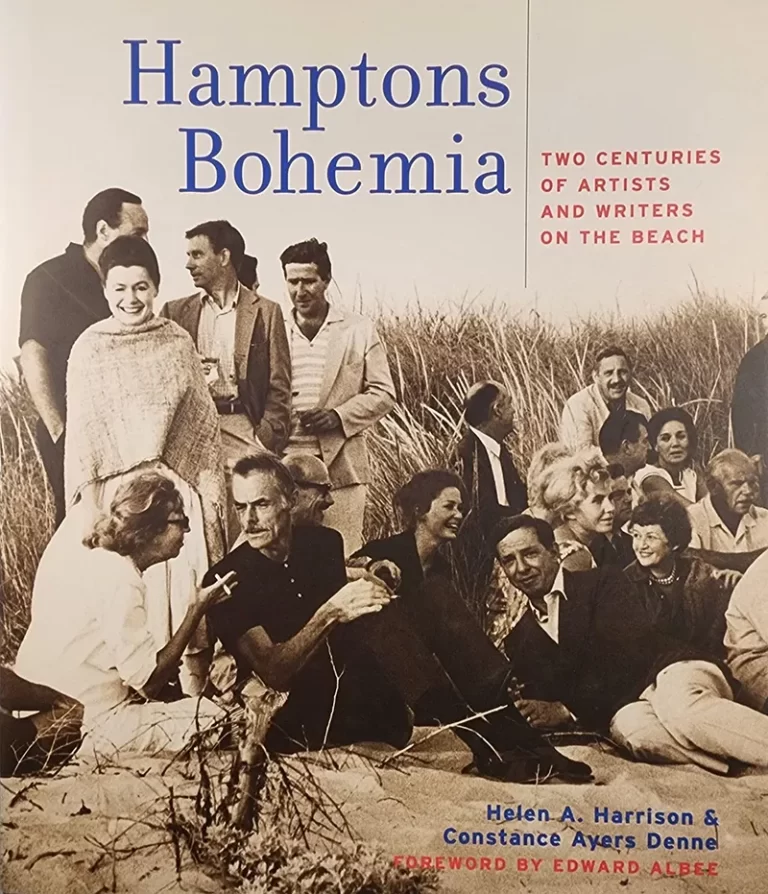
Her books include Larry Rivers (Harper & Row, 1984), Hamptons Bohemia: Two Centuries of Artists and Writers on the Beach, The Jackson Pollock Box. She has also authored a series of historical mystery novels collectively titled The Art of Murder, set within the twentieth-century New York art world and blending fictional and historical figures.

Phyllis Baker Hammond was an internationally acclaimed sculptor, artist, designer, and educator – Her career spanned 7 decades, of which 30 years were based in The Springs. Her work is characterized by innovation across multiple mediums, with a commitment to abstract expressionism. Her early work was in ceramics and clay sculpture, serving as a designer of dinnerware at Corning, and her work sold at Macys, Saks, and Neiman Marcus. She received numerous public commission throughout her career. she also designed the William Shakesperare Award for Classic Theaster (The Will Award) to such recipients as Morgan Freeman, Dame Maggie Smith and Sir Anthony Hopkins. She was the founding member of Longhouse Reserve, and president of the Artist Alliance of East Hampton, and active with Guild Hall. She received a National Endowment for the Arts grant in 1961. Hammond’s work was showcased in over 30 group exhibitions and numerous solo shows throughout her career in the US, Switzerland and Japan.
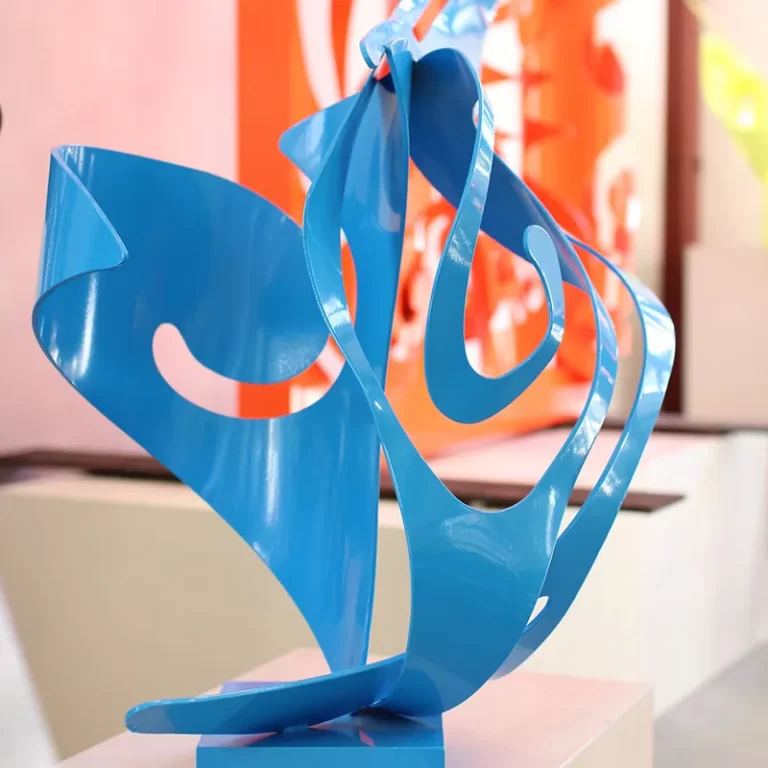
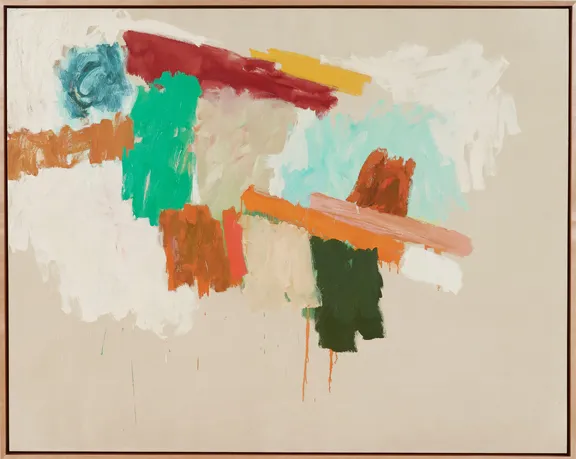
Originally from San Francisco, Ferren was known as an intellectual among his peers. He wrote many published articles on abstract art and art theory. In the 1920s, while in Paris, Ferren was part of a art community including Duchamp, Ernst, Giacometti, Matisse, Miro, and Picasso. Mentored by Picasso, together they stretched the canvas from Picasso’s large 1937 painting titled “Guernica”. He was the only artist included an inner circle member of the Parisian avant garde group “Abstraction-Creation” in the 1930’s and also part of the New York School of Abstract Expressionists of the 1940s and 1950’s. In 1938, he was founding member and the President of “The Club”– an original group of emerging New York School of Abstract Expressionism. He taught at Brooklyn Museum of Art School, Cooper Union, Queens College, Art Center College of Design and UCLA. In the 1950’s Ferren collaborated with Alfred Hitchcock on 2 films “The Trouble with Harry” and “Vertigo”. His pieces are the permanent collection of leading museums in America including the Guggenheim Museum, Smithsonian American Art Museum, MoMA, LA County Museum of Art, The Whitney Museum of American Art, The San Francisco Museum of Art , The High Museum of Art, Guild Hall, The Hirshhorn Museum, Parrish Art Museum, The National Gallery of Art, and Yale University Art Gallery. He has been included 70+ museum and gallery exhibitions, including the famous Stable Gallery Show (1954-1958). Ferren, along with friend Willem de Kooning, purchased adjacent land and a house in The Springs where he lived full-time while maintaining a studio in NYC on Spring Street. He was an active member of the East Hampton artists community, working closely with Guild Hall.

She has been featured in over 130 solo and group shows nationally and internationally. Foss teaches painting at The National Academy, and The Arts Student League.
Her works are in the public collections of MoMA, National Portrait Gallery, The Houston Museum of Art, Guild Hall, The Brooklyn Museum, The Wichita Art Museum, The Museum of Oklahoma, The National Museum of Women in the Arts and The Huntington Museum.
Read more about her in the May/June issue of Fine Art Connoisseur.

Connie Fox, whose art career spanned seven decades, received her BFA in 1947 from Un. of CO, and attended Art Center School, LA for a rigorous program of drawing, perspective, rendering, and composition. She received her MA at the Un. of NM, Albuquerque in 1952, where she then taught and met artists Elaine de Kooning (1918-1989) and Robert Dash (1931-2013) who later encouraged her to move to the East End of Long Island.
In the traditions of Abstract Expressionism and Surrealism, Connie Fox was an original, and as Amei Wallach wrote, “a super collider of painting…[who] accelerates particles of line, shape, dimension, improbable hue…into emanations of energy. The integrity and sheer exuberance of her life in art is exemplary and it is rare.”
Connie Fox and her husband, sculptor William King (fellow inductee into the HFAF 2024 Hall of Fame), made their home together and worked in the studios they built in East Hampton’s Northwest Woods through the last 40 years of Fox’s life.
Her most recent solo exhibitions were with Danese/Corey Gallery, NY and the Heckscher Museum. Fox’s works are included in the collections of major museums and galleries across the country, including the Parrish and Guild Hall; the American Academy of Arts and Letters; Albright-Knox Art Gallery; Brooklyn Museum; and the University of Florida, Gainesville.

William King was a pivotal figure in American sculpture. Born in Jacksonville, Florida, in 1925, he grew up in Coconut Grove, Miami. He arrived in New York in 1945, enrolled in Cooper Union, and upon graduation in 1948, won a scholarship to the Skowhegan School of Painting and Sculpture, in Maine. He traveled to Rome on a Fulbright scholarship, and later to Athens, and to London. His first solo show was at the Alan Gallery, in New York, 1954, and he continued to show his work, both at home and abroad, for the next 60 years. King’s art is in the permanent collections of the Guggenheim Museum, the Hirshhorn, the Whitney, the Met, among many others, and his public commissions are placed in 18 locations throughout the U.S. A member of the American Academy of Arts and Letters, he also served as president of the Academy of Design, 1994-98. He received Lifetime Achievement Awards from Guild Hall in 1997, and from the International Sculpture Center, 2007. He lived with his wife, Connie Fox (2024 Hall of Fame inductee), in the Northwest Woods for 33 years. Hilton Kramer wrote: “The sculpture of William King is a sculpture of comic gesture.” He appeared in 3 of the now famous Stable shows (1955-57).
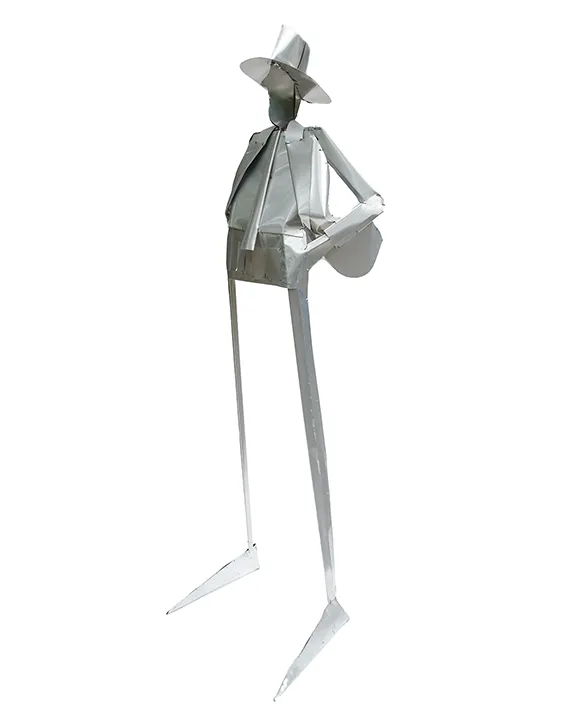
As long time Hamptons resident, Lanser is a leading second generation abstract expressionist artist, during the famed 1950-70’s era, as a member of the respected New York School of the Arts. Originally from Philadelphia, Lansner began her education at Tyler School of Fine Arts, then moved to NYC in 1948, where she studied with Hans Hofmann and at the Arts Student League. In 1951, she was thrust into the height of the Abstract Expressionist movement, where she became affiliated with Willem de Kooning, Joan Mitchell and Franz Kline. She was briefly a member of the esteemed Artists Club, but felt relegated by the male members. She worked in the 10th street Studio building, and showed in 1954 at the Hansa Gallery as well in the Hamptons with fellow artists Miriam Shapiro, Willem and Elaine de Kooning, and Larry Rivers. In the mid 1950’s the Lansers began to spend summers in The Springs, where she made lifelong friends with Larry Rivers, Perl Fine, Audry Flack, and critic Harold Rosenberg.
In the 1970’s Lansner was often identified as a feminist artist. In 1971, she co-founded the Women in the Arts, an organization seeking to change both public and institutional attitudes toward women artists. In 1972, the group demonstrated in front of MoMA protesting discriminatory curatorial practices. As a result, the landmark Women Choose Women show of works by 109 women artists opened shortly after, at the New York Cultural Center. Lansner is known for her recognizable work, painting and drawing the human figure, which is based on her Hofmann training, and her interest in abstraction and figuration. Despite her impressive record of 60+ exhibitions, she is known to art historians of mid 20th century art, and has not received the adulation she deserves, until now. Her artistic legacy is one of a woman strong enough to remain true to her own principles throughout her prolific career.

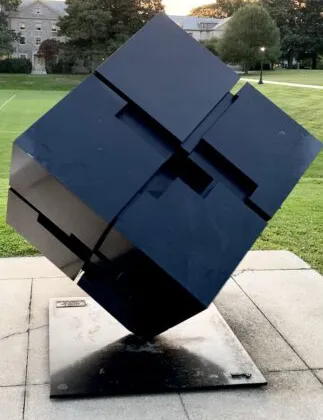
Tony Rosenthal is recognized as one of the leading American abstract sculptors of the 20th century. He is widely remembered for his 100+ monumental public art sculptures in many of the nation’s largest cities. His arc of sculptures range in size, style and media – including wood, steel, bronze, brass, cement and aluminum. Rosenthal has shown in numerous museums, including the San Francisco Museum of Art, MoMA, and The Whitney Museum of American Art, with solo exhibitions at Kootz Gallery and M. Knoedler & Co. His work is in the permanent collections of 30+ prestigious museums such as The Whitney Museum of American art, Albright-Knox Art Gallery, The Israel Museum, MoMA, National Museum of American Art at the Smithsonian, The National Gallery of Art, The Guggenheim Museum, Yale University Art Gallery, Los Angeles County Museum of Art, Milwaukee Museum of Art, and San Diego Museum of Art, just to name a few. Rosenthal is probably best known for the 1,770 pound, 15 ft. CorTeen cube, “The Alamo,” also known as the “Astor Place Cube”, which in 1967 was the first permanent contemporary outdoor public sculpture in NYC. Other important pieces are “Cranbrook Ingathering” at Michigan Design Center, and “Holocaust Memorial”, at the Jewish Community Center in Buffalo. He dedicated his life to creating art, and actively created sculpture everyday in his Southampton studio, not far from the HFAF site. He lived to 94.
Known professionally, simply as Strong-Cuevas, she was a sculptor known for monumental creations of figurative sculptures of large heads, many of which were in profile, made in steel and bronze. Later in life, her highly abstract, cubist, and totemic works consisted of human faces rendered from multiple angles.
Growing up, she was said to be the favorite grandchild of John D. Rockefeller, the Gilded Age tycoon. She studied at the Arts Students League of New York, learning wood and stone carving under the tutelage of John Hovannes in the mid-1960s. Besides bronze, some of her works have been cast in stainless steel and aluminum. Sculptures by Strong-Cuevas have been exhibited in one-person shows in New York City, Poughkeepsie, the Hamptons, and at the Grounds for Sculpture in Hamilton, New Jersey.
Her works have appeared in group exhibitions in leading galleries and museums, such as The Bruce Museum, Kouros Gallery, in Connecticut, The Parrish Art Museum, Southampton Arts Center, Shidoni Contemporary, Biennale III and IV in Monte Carlo, the Tolman Collection in Singapore, Grounds for Sculpture, Guild Hall, Long Island Museum, and Heckscher Museum of Art, where several of her works are in their permanent collection.
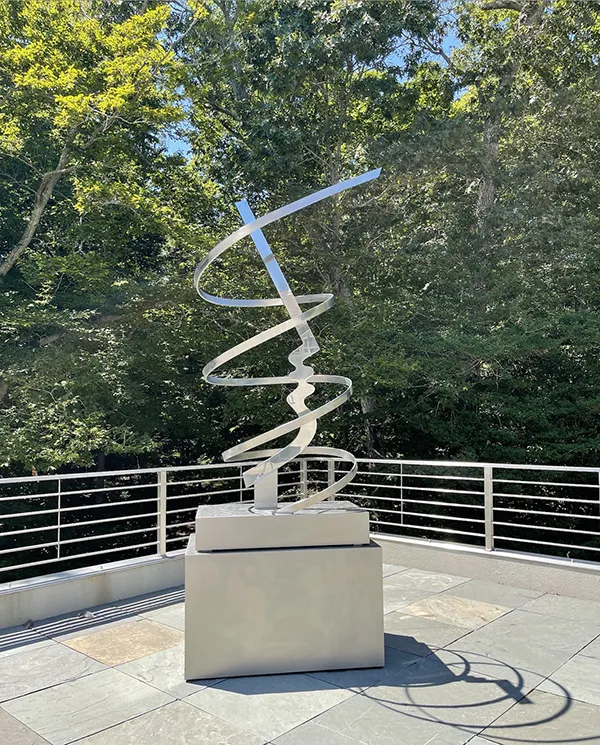
Van deBovenkamp is considered one of America’s foremost contemporary abstract sculptors. He is renowned for his monumental sculpture created for open air public locales. His abstract pieces in bronze, stainless steel, painted steel, and aluminum, have a signature power, lyricism, and grand proportions which heightens the viewer’s sense of imagination and discovery. Van de Bovenkamp has earned an international reputation for designing, fabricating, and installing over 100 unique commissioned sculptures and foundations in various cities, museums, and private homes. He has been featured in 35 solo exhibitions, and over 70 group shows. Recent exhibitions include Grounds for Sculpture, Danubiana Meulensteen Museum, Season of Sculpture, Guild Hall, Miami University Art Museum, Boca Raton Museum of Art, Lowe Art Museum, and Butler Institute of American Art. During the 1960s, while working in a studio on Christoper Street, in NYC, he had 15 assistants including well known George Rhoads and Sybil and David Yurman. In 2021-2023, Louis K. Meisel Gallery organized the Hans Van de Bovenhamp Hamptons Sculpture Tour, featuring more than a dozen sculptures on the lawns of local businesses and residences in the Watermill, Bridgehampton, and Sagaponack region.

William Tarr was a monumental sculptor, painter, bestselling author, Guggenheim Fellow and longtime resident of Springs, East Hampton. While he began his creative career as a painter, by1958 his focus had shifted to sculpture. Tarr is best known for his 63-ton welded-steel memorial to Martin Luther King, located at Martin Luther King Jr. Educational Campus on Amsterdam Avenue, NYC, near Lincoln Center. The work took three-and-a-half years to complete and was selected Best Monument in NYC by New York Magazine.
Over the years Tarr accepted many challenging commissions including in a 13-ton welded-steel sculpture adorned with numbers and letters for Harlem Public School 36 (1967); a full-scale welded-steel replica of a World I Sopwith Camel biplane, complete with lighted runway, installed atop the 27th floor of 77 Water St, NY (1979); and “Gates of The Six Million”, a 9-ft. tall, 5,400 lb. cast bronze memorial at the Holocaust Museum, Washington, D.C.
His work is in collections of the Whitney Museum, the Chicago Art Institute, the Denver Museum of Art, Guild Hall Museum, and other notable collections.

Amy Zerner is a multi-disciplinary artist and the recipient of a National Endowment for the Arts Visual Artist’s Fellowship Grant in the Category of Painting. She attended Pratt Institute and has made her home in East Hampton, NY since 1967, where she lives with her husband, author Monte Farber. Amy has exhibited her mixed-media work extensively in the Hamptons, most recently at MM Fine Art in Southampton, NY. Her unique collage style combines various fabrics, unique textiles, and found objects to create visually stunning and spiritually meaningful works.
Amy has sold her one-of-a-kind art couture jackets, coats and caftans at Bergdorf Goodman for 24 years, along with her unique jewelry designs. Her tapestries and collages have been included in the collections of many prominent individuals including Oprah, Shirley MacLaine, Dame Elizabeth Taylor, Rhianna, Patti LaBelle, Martha Stewart and Michael J. Fox.
She has had many one-person shows at venues such as the Myers Gallery at the State University of New York in Plattsburg, University of North Texas ArtSpace, Eastern Kentucky University Giles Gallery, Las Vegas Cultural Center, First Woman’s Bank, Callenwolde Fine Arts Center, and The Islip Art Museum.
Her work has been shown in many group shows, including the Museum of American Craft, Lebanon Valley Collage Art Gallery, Downey Museum of Art, Pacific Lutheran University, Parrish Art Museum and Guild Hall Museum.
Her artwork illustrates the best-selling mind/body/spirit books and tools she has created with Monte, with nearly 3 million copies in print in 18 languages. A feature length documentary about the couple “Amy & Monte: A Legacy of Love and Creativity” has been produced and will be released Fall 2024.
